The use of drugs as a means for artists to expand their minds is a controversial topic, but an important one to discuss. Often, drugs can challenge the user to view the world in a completely new way and can be used as a catalyst for inspiration and ingenuity. After learning this week of how drugs and art have intersected, I immediately thought of the artist Bryan Lewis Saunders. Saunders is an artist who became famous for drawing self portraits while on a variety of different drugs.
His self-experiment and the results are not only important for the art world, but for the scientific world as well. They give the viewer insight into what the user is experiencing while on these drugs and the effects they have on the mind. They also cause one to ask such questions as: what is perception? What is consciousness? What are hallucinations, and do drugs break down the barrier between unconscious and conscious thought?
Diagram of the weight of the conscious vs. unconscious mind <https://schriftman.files.wordpress.com/2010/11/unconsciousmind.jpg>
These are important questions, as the diagram to the right illustrates, based off of the theories of Freud and Jung, the unconscious mind composes a significant part of our minds. Perhaps drugs unleash this unconsciousness, and as illustrated by the artwork of Saunders, allow one to tap into the hidden creative energies of the unconscious mind.
Image illustrating the weight of the unconscious vs conscious mind in the human brain <http://www.curezone.org/upload/_T_Forums/turiya_file/conscious_subconscious_unconscious1_longated.png>
Though condoning drugs for the purposes of 'mind expansion' and 'artistic expression' is a slippery slope, in moderation, I believe that in can produce incredible results for both artists and scientists.
References:
Vesna, Victoria. "Neuroscience and Art." UCLA. Los Angeles, CA. 30 Apr 2016. Web. 10 May 2016.
Saunders, Bryan Lewish. "Under the Influence."Bryanlewissaunders.org. N.p., 2008. Web. 10 May 2016. <http%3A%2F%2Fbryanlewissaunders.org%2Fdrugs%2F>.
Freud, Sigmund, and James Strachey. The Ego and the Id. New York: Norton, 1962. Print.
Jung, C. G., and Mrs Beatrice Moses Hinkle. Psychology of the Unconscious; a Study of the Transformations and Symbolisms of the Libido, a Contribution to the History of the Evolution of Thought. New York: Moffat, Yard, 1916. Print.
Korte, Travis. "The Influence of Drugs in Art History." The Huffington Post. TheHuffingtonPost.com, 20 Apr. 2011. Web. 11 May 2016. <http://www.huffingtonpost.com/2011/04/20/the-influence-of-drugs-in_n_851643.html>.
Stelarc with the third ear he implanted into his forearm
<http://i2.cdn.turner.com/cnnnext/dam/assets/150812130237-stelarc-large-169.jpg>
As a biology major who has been involved in research since my sophomore year, I found this week's lecture to be a bit frustrating.Though I understand why artists want to use advances in biotechnology to further artistic expression, I personally believe that some of the artists that were covered in lecture wasted resources and money on useless projects. The artist Joe Davis is an example of this. Though I can appreciate his desire to push the boundaries of what is considered art and the philosophical discussions that arise due to his ideas, I find, for example, his pursuit to codify a poem and input it into the genome of a frog, as wasteful and unnecessary. These technologies are not cheap to use, and seeing someone use them to create a work of art that nobody can physically see is nonsensical to me.
Stelarc with a robotic third arm
<http://people.ucsc.edu/~joahanse/onlineexhibit/thirdhand/stelarc.jpeg>
Davis codified this symbol, of the human genitalia, put it into E.coli, and sent them into space as a 'message' for extra-terrestrials
I felt the same way with respect to Stelarc's "3rd ear" that he implanted beneath the skin on his forearm. He believes that "art is interesting when it becomes surprising," and with this mindset, it makes sense as to why he believes that implanting an ear onto his forearm is "art." But from my perspective, there is a line to be drawn between what art is and what it is not. If implanting an ear onto your forearm is art, then where is the line drawn? Perhaps hooking yourself up to an IV from your forehead veins is also art? Though I understand that this is an extremely complex discussion on 'what is art,' I believe it is important for artists and scientists to work together to create certain ethical boundaries. This incredible technology does not come cheap, and it is aggravating for me to see it be used in this way. There are people across the world who do not have access to the most basic medicine, and here in the United States we have artists being commissioned to implant unnecessary ears onto their arms.
References:
Vesna, Victoria. "Biotech and Art." UCLA. Los Angeles, CA. 20 April 2016. Web.
Nadis, Steve. "Creating Art from Microbes and Molecules." Discover Magazine. 29 Mar. 2013. Web. 07 May 2016.
"Artist Implants 'third Ear' on His Own Arm." Mail Online. Associated Newspapers, 11 Oct. 2007. Web. 07 May 2016.
House, Patrick. "Object of Interest: The Twice-Forbidden Fruit." The New Yorker. 13 June 2014. Web. 07 May 2016.
"Joe Davis (artist)." Wikipedia. Wikimedia Foundation. Web. 07 May 2016.
For my first event, I attended the LASER lecture on UCLA's campus. The event included about 7 speakers, each of whom spoke for about 5-7 minutes regarding their research/ artwork. What I found to be most interesting was the mixture of artists and scientists present. Scientists showcased their works about solar panel technology and robotics, and many of the artists there utilized technology (mostly lights, video recordings, sound, and simple robotics) to create their works.
Dr. Vesna introducing one of the speakers
Specifically, I want to focus on one of the lectures I saw concerning solar panels titled "The Future of our Energy Landscape: Could Plastic Solar Cells Meet our Energy Needs?". I am choosing to focus on this lecture as I understood its scientific implications the best and could see how heavily this product could influence the artistic world, as well as the general public. This heavily relates to the robotics/technology and art lectures we have studied so far.The lecture, as its title says, focused on creating plastic solar cells. The lecturer briefly described how electricity is generated through solar cells, then delved into plastic solar cells, specifically.
When she began describing the implications for this technology in the future, I became very excited. The genius behind plastic solar cells are that they are flexible and can be rolled out. What does this mean? Imagine every surface, sidewalks, bus stations, traffic lights, and buildings covered in solar panels. With an artistic eye, these solar panels can decorate our streets and make them truly beautiful while providing us with an endless supply of energy. The technology also has implications for wearable electronics, electronic clothing. and can push the boundaries of kinetic/electronic art. Artists can utilize this technology to power their robotics artworks and in collaboration with scientists can create designs that beautify the world we live in.
Overall, the lecture series was very interesting. However, to be honest, I did not enjoy most of the works of art I saw from the artists who presented. The majority of their art was too abstract and random for my taste, and seemed to simply pile a bunch of technology onto each other (videos, lighting in a room) and call it 'art.' It's important to note, however, that everyone has different tastes in art.
Me taking a horrible quality selfie outside the gallery
Link to the event, and link to Art|Sci Gallery at UCLA: http://artsci.ucla.edu/?q=laser-leonardo-art-science-evening-rendezvous
References:
Pupols, Melody. "UCLA Chemists Devise Technology That Could Transform Solar Energy Storage." UCLA Newsroom. 18 June 2015. Web. 03 May 2016.
Growing up with an ultrasound technician for a mother, I was always awed by how science and technology could be used to look into a human's body. What was especially amazing was that the ultrasound machine that my mother so non-chalantly dealt with was emitting high frequency sound that was capable of breaking into a person's body to reveal what was going on inside. It sounded like something straight out of science fiction to me.
12 week old fetus in the womb
<https://upload.wikimedia.org/wikipedia/commons/2/2f/CRL_Crown_rump_lengh_12_weeks_ecografia_Dr._Wolfgang_Moroder.jpg>
After this week's lecture, I began to think more about how medical technologies could be and have been used for artistic expression, specifically focusing on X-Ray technology.
Around this time last year in Santa Monica, the Ad Council created an interactive piece using X-Rays to portray the different types of love that are present in society, to reinforce the concept in people's minds that we are all the same on the inside. People, regardless of age, size, gender, nationality stepped behind an X-Ray screen. The audience watching the screen could only see the X-Ray images of the individuals, and not any other factors. For me, this was an incredibly powerful ad that seamlessly melded the spheres of science and art to effectively encourage critical thought. It created an experience that deeply moved the viewers.
X-Ray art, I surprisingly learned, is not something new, but has been around for almost 100 years. Artists today still utilize this relatively simple technology to create their works. What strikes me as the most interesting are the philosophical conversations that can emerge as a result of this type of artwork. Through X-Rays, you can transcend the outer appearance of the body or an object to literally look inside it.
X-Ray skulls overlapped with different images
<http://lh5.googleusercontent.com/-zreiSB4dUgo/Te_91ZEEWLI/AAAAAAABfAU/ITe4vyOA8ZM/s720/y4.jpg>
X-Ray of gun with rose
<https://farm9.staticflickr.com/8684/17192967419_7063f18eb6_b.jpg>
I doubt that Roentgen ever imagined that the medical technology he developed in 1895 would be applied in the manner it is being applied today. Roentgen's X-Ray technology not only opened doors in the medical profession, but created an entirely new medium through which artists could create visually astounding works of art.
References:
Vesna, Victoria. "Medicine, Technology, and Art." UCLA. Los Angeles, CA. 21 April 2016. Lecture.
Ad Council. "Love Has No Labels." Online video clip. Youtube. 10 Mar 2015. Web. 21 Apr 2016.
<https://www.youtube.com/watch?v=PnDgZuGIhHs>
Keady, Cameron. Huffingtonpost.com. "Giant X-Ray Screen Erases Gender, Age, Race to Prove 'We Are All Human.' "Huffington Post. 5 Mar 2015. Web. 21 Apr 2016
Machines enabled art to be mass produced for the first time, which for philosophers such as Walter Benjamin, took the authenticity, uniqueness, and originality out of art. Benjamin stated that its [the artwork's] 'presence is depreciated.' To an extent, I agree with Benjamin's outlook. Important and classical works of art, such as Da Vinci's Mona Lisa, the Eiffel Tower, and Dali's The Persistence of Memory have been reprinted and photographed so often that the viewer has lost that sense of awe when looking at these works of art. To be honest, I have seen images of these artworks so frequently throughout my life that they have lost their artistic significance for me.
The mass production of the Mona Lisa, this iconic image today is reprinted on T-shirts, bags, mugs, and a variety of objects.
https://blogger.googleusercontent.com/img/b/R29vZ2xl/AVvXsEh0nqWavGPCcyLSOjL06B66uHX3zgnMCZf1PK5dGvCSgwRj7RN8G1B4PJgATTM1ad0a6SvCXCYVOOok98B-nCQhJk0T2JXuufDC0cM6v18SIMTh-ayTgU6UWN4CwvBLCYspJyZiKUl67noR/s1600/6.png
Though I agree with Benjamin's assertion, I believe that the concept of mass production forced and encouraged artists to create artwork that could not be replicated. Furthermore, it is important to note that the 'aura' of the artwork is a feeling manufactured by the viewer, not the object. So though for me viewing the Mona Lisa elicits no emotional response, for someone who feels a connection to the painting itself, the essence of that painting is maintained, regardless of how many times it has been reproduced or seen by the individual.
The face of the Prague Astronomical Clock (1462)
https://en.wikipedia.org/wiki/History_of_timekeeping_devices
This balance between machines and art is most evident, to me, in the form of clocks. Clocks represent the ultimate convergence of machinations and art. Though there are bland clocks, there are also those that push the boundaries between art and science. And it is these clocks that, regardless of how many times they have been reproduced, still instill in me a sort of wonder, curiosity, and intrigue. Beginning in the early 15th century, clocks expertly meshed the boundaries between machines, astronomy, physics, and art.
A kinematic clock created by the artist Gordon Brandt
http://www.gordonbradt.com/clocks.htm
A modern clock that is both functional timepiece
and work of art
In modern times, though clocks are mass produced, the unique one's maintain their originality regardless of how many times they are reproduced. In my opinion, these clocks maintain the 'essence' that Benjamin argued is lost when products are mass produced. In the clock, we see a perfect and ancient example of art, science, and robotics blending together to create something more beautiful, a feat that has stood the test of time.
References:
Vesna, Victoria. "Robotics and Art." UCLA. Los Angeles, CA. 10 April 2016. Lecture.
Benjamin, Walter, and J. A. Underwood. The Work of Art in the Age of Mechanical Reproduction. London: Penguin, 2008. Print.
"History of Timekeeping Devices." Wikipedia: The Free Encylopedia. Wikimedia Foundation, Inc. 25 Feb, 2016. Web. 10 Apr, 2016.
<https://en.wikipedia.org/wiki/History_of_timekeeping_devices#Mechanical_clocks>
Marie, Niclas. "Managing Ancient Schedules: A Look at Ancient Timepieces." Web blog post. Timecenter. 12 Jan 2016. Web. 10 Apr 2016.
<https://www.timecenter.com/articles/managing-ancient-schedules-a-look-at-ancient-timepieces/>
Tom. "25 Cool and Unusual Clocks." Web blog post. Boredpanda.com. 12 Feb 2012. Web. 10 Apr 2016.
Bradt, Gordon. "Kinetic Art and the Desk Top Clock." Web blog post. Gordonbradt.com. 10 Mar 2010. Web. 10 Apr 2016.
<http://www.gordonbradt.com/clocks>
This week's lecture and notes were amusing since I have always considered a basic understanding of mathematics (specifically geometry) essential in creating realistic artwork. It was interesting to see the strength of the divide that has been created between these two disciplines when in fact, art would not be what it is today without advances in mathematical understanding.
A pre-Renaissance art piece with disproportionate dimensions and no perspective.
My early art pieces looked similar to this one.
The link between math and art became obvious for me as a teenager, when I first began drawing. My early artwork resembled those of the pre-Renaissance era, namely, they were flat, had a one point perspective, and were proportionally off.
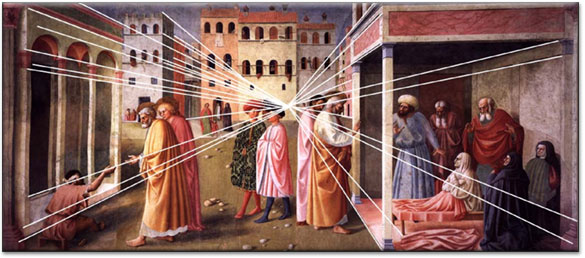
Eventually, I learned about linear perspective, optics, and geometry by studying Renaissance era art, which to me as an amateur artist looked incredibly realistic and proportionally sound.
Masolino's 'St. Peter Healing a Cripple and the Rising of Tabitha' with perspective lines.
Creating proportionally accurate drawings is very time consuming and difficult, and I am still not very good at it. The above painting has almost perfect perspective lines, and I have yet to wrap my mind around how exactly this works. Without a deep understanding of optics, I find it very difficult for me to create realistic artwork, and this just reinforces in my mind the concept that mathematics and art are intricately linked.
We can even see the relationship between math and art in contemporary artworks. This is evident at UCLA where 2 mathematics professors were hired by Disney studios to help Disney create an algorithm for snow, in order to make the snow in the movie Frozen look more realistic (http://newsroom.ucla.edu/stories/math-wizards-create-snow-for-disney-263913). The video to illustrates the technique that the math professors created.
The clip on the left shows how the techniques the professors developed were applied in the movie.
From M.C. Escher's art, to intricate mathematical origami, to UCLA mathematics professors studying snow, mathematics continues to build and create new avenues for artists to shape their worlds. Like many things that are portrayed as black and white in society, an incorrect juxtaposition exists between mathematics and art that clearly defies reality.
References:
Vesna, Victoria. "Math + Art." UCLA. Los Angeles, CA. 4 April 2016. Lecture.
Haikudeck.com. One-Point Perspective. Unknown. 18 November 2015. Web. 1 April 2016.
<https://www.haikudeck.com/1-pt-perspective-art-and-design-presentation-YGZfnRpH47#slide0>
Frantz, Mark. Mathaware.org. Drawing with Awareness. Indiana University, April 2003. Web. 1 April 2016. < http://www.mathaware.org/mam/03/essay6.html>
Walt Disney Animation Studios. Disney's Frozen: A Material Point Method for Snow Stimulation. Online video clip. YouTube. 13 November 2013. Web. 1 April 2016.
<https://www.youtube.com/watch?v=9H1gRQ6S7gg>
Walt Disney Animation Studios. Disney's Frozen: Wolf Chase Clip. Online video clip. YouTube. 28 October 2013. Web. 1 April 2016.
<https://www.youtube.com/watch?v=qF7AfwMzrpc>
Da Panicale, Masolino. St. Peter Healing a Cripple and the Rising of Tabitha. 1400. Fresco. Brancacci Chapel, Florence.